Cultural Heritage Baseline Surveys and Assessments
The Arabian Peninsula’s history spans over 100,000 years of human occupation, leaving a rich legacy of tangible cultural heritage. These assets hold intrinsic cultural, scientific, and socio-economic value, and are protected under national legislation and international standards. Our services identify, document, and assess cultural heritage resources to ensure they are appropriately managed, preserved, and integrated into responsible development planning.
Cultural Heritage Baseline Surveys and Assessments
With more than 100,000 years of continuous human presence, spanning the Palaeolithic, Mesolithic, Neolithic, Iron Age, and Islamic periods, the cultural heritage of Arabia is as rich as it is subtle.
Cultural heritage surveys are conducted or supervised by qualified professional archaeologists with extensive regional research experience. Surveys utilise non-invasive field methodologies, including systematic walkover surveys and geo-referenced documentation, to record cultural resources. Identified features are interpreted and evaluated for archaeological significance and sensitivity, forming the basis of a Cultural Heritage Management Plan (CHMP).
Where required, management planning incorporates Chance Find Procedures in accordance with International Finance Corporation (IFC) Performance Standard 8, ensuring compliance with both national authorities and international lender requirements.
Did You Know?
Southern Arabia is associated with the early expansion of modern humans out of Africa, with archaeological and genetic evidence indicating human occupation dating back over 100,000 years before present.
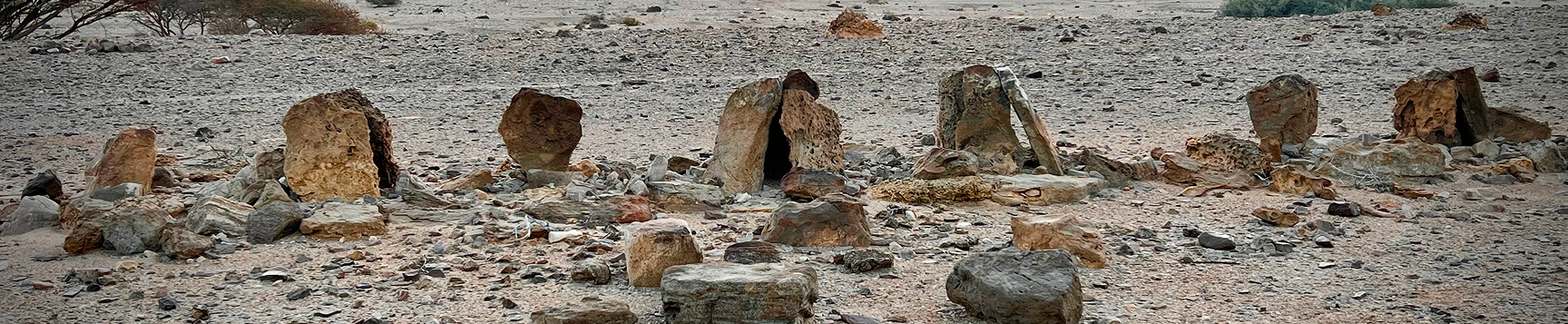
Triliths, enigmatic stone structures dating to the late Iron Age (circa 500 BCE), are associated with distinctive cultural traditions in Southern Arabia, including Oman and Yemen.
Lithics — the tools and waste material produced during stone tool manufacture — are frequently found in areas where raw material sources coincide with former water bodies present during wetter climatic phases of the late Pleistocene.
Relocation of Islamic-era graves from development sites requires approval from the Ministry of Islamic Affairs and Awqaf, while movable artefacts and structural remains must be investigated and, where appropriate, rescued under the supervision of the Ministry of Heritage and Tourism.